page

Showing posts with label Text. Show all posts

Tuesday, March 11, 2014

Professionalism Best Mechanism to Protect Journalists, Expert Says

11 March 2014
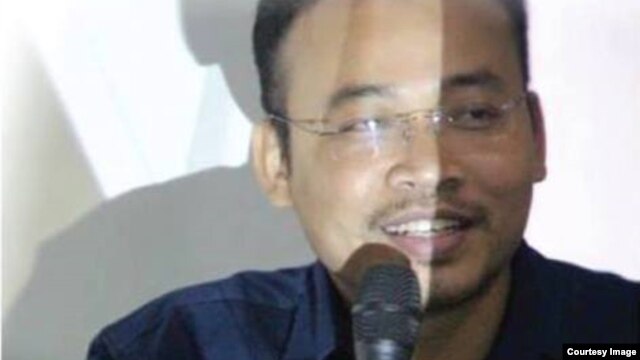
Som Ratana, acting director of the department of media and communication at the Royal University of Phnom Penh, told “Hello VOA” on Monday.
PHNOM PENH — Journalists need to be more professional in their reporting, which is the best way to protect themselves, a media educator says.

“Like any other profession, journalism can be risky, but if journalists follow their professional codes of conduct and ethics and work with responsibility, there should be no problems for them,” .
Som Ratana, acting director of the department of media and communication at the Royal University of Phnom Penh, told “Hello VOA” on Monday

In fact, Cambodia can be quite dangerous for reporters, and nearly a dozen murders of journalists over the years have gone unsolved. In recent labor demonstration crackdowns, several journalists were injured.

Wednesday, February 19, 2014

Political Parties Agree on Way Forward for Political Reform

19 February 2014
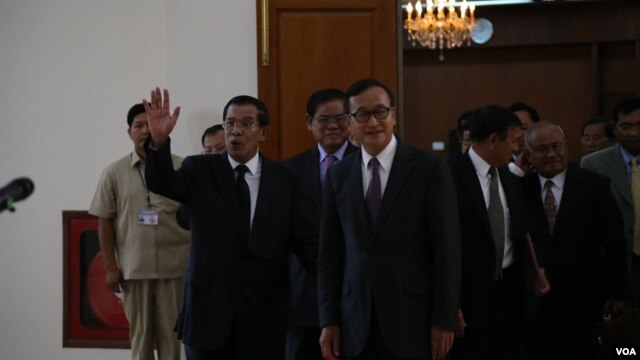
Hun Sen and Sam Rainsy meet for the first time after election on Sept 14, 2013. (Photo by Heng Reaksmey VOA Khmer)
PHNOM PENH — Cambodia’s ruling and opposition parties reopened negotiations on Tuesday, seeking to end a political deadlock that has been in place since July’s national elections.

Negotiators from the Cambodian People’s Party and the Cambodia National Rescue Party spoke for more than two hours at the Senate building in Phnom Penh, agreeing to look for ways to reform Cambodia’s political process.
The two sides said in a joint statement they hoped to organize a national forum that would draw from the international community, local NGOs and other interested parties to work on reform.

Cambodians Becoming Less Likely Tolerate Corruption: Advocate

19 February 2014

Preap Kol, executive director of Transparency International Cambodia, on “Hello VOA” last week.
PHNOM PENH — An anti-corruption advocate says Cambodias no longer regard corruption as an everyday occurrent they must tolerate.

“Cambodian people today have changed their attitude of ignorance to paying attention to corruption because they now understand its impacts more than before,” Preap Kol, executive director of Transparency International Cambodia, told “Hello VOA” last week.
Cambodia was listed as the most corrupt country in Southeast Asia last year, according to Transparency International’s annual index, which measures perceived corruption. And a recently released survey by the US-based International Republican Institute found that nearly 50 percent of Cambodians view corruption and nepotism as serious problems facing the country.

Saturday, December 14, 2013

Expert Touts Rise of Citizen Journalists

14 December 2013

A journalist takes a photo using a smart phone during a press conference, file photo.
PHNOM PENH — Citizens can be journalists, and they can help Cambodia face ongoing issues like illegal logging, rights abuses and corruption, a communications technology expert says.

Ngeth Moses, ICT coordinator for the Community Legal Education Center, told “Hello VOA” Monday that new tools are making it easier for so-called citizen journalists to emerge.

“They can get audio and video from the field where those problems occur, and share them quickly on social media,” he said.

Thursday, October 17, 2013

‘Hungry’ Teachers Need Better Pay, Educator Says

17 October 2013

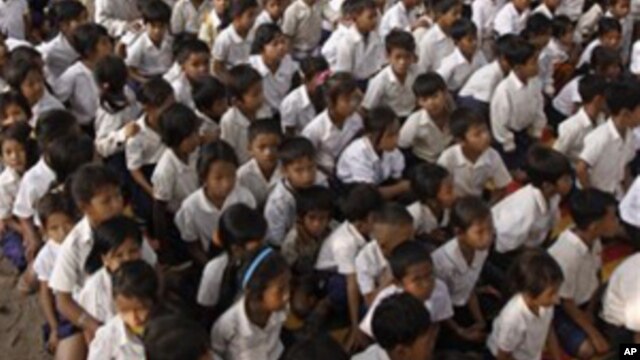
Cambodian school children sit under the shade of tree as they listen to teacher at Trapaing Loeuk primary school in Kampong Speu province.
PHNOM PENH - An increase in teacher salaries and the elimination of administrative corruption are key reforms needed to ensure improved education and competitiveness for Cambodian youths, an educator says.

“Some teachers say that with hungry stomaches, they cannot teach,” Pa Chanroeun, a PhD candidate at Charles Stuart University in Australia, told “Hello VOA” on Monday. “So there must be decent salaries for educational personnel, especially teachers.”

Cambodia’s teachers earn about $100 per month, leading many to resort to low-level bribe-taking to make ends meet. The government has said it cannot afford higher wages for more than 112,000 education personnel nationwide.

Monday, April 30, 2012

Cambodia Activist Laid to Rest After Shooting Death

Say Mony, VOA Khmer
Monday, 30 April 2012

Chut Wutty, a prominent Cambodian anti-logging activist who helped expose a secretive state sell-off of national parks was fatally shot on April 25, 2012 in a remote southwestern province, FILE February 21, 2012.
Family members and activists vow to follow a prominent environmentalist's footsteps after his shooting death in Koh Kong province last week.

Chut Wutty, director of Natural Resource Protection Group, was shot and killed in a forest while escorting two journalists covering illegal logging. A military policeman was killed in the same incident and the Cambodian government says it will establish a joint committee to investigate.

Saturday, June 4, 2011

Delay on Sesan River Hydrodam Unlikely: Officials

Say Mony, VOA Khmer | Phnom Penh 
Saturday, 04 June 2011

Government officials say any delay on the construction of a hydropower dam on the Sesan river in Stung Treng province is unlikely, even though residents along the river say they want more impact studies conducted.

Prach Sun, secretary of state for the Ministry of Environment, told VOA Khmer the government has already conducted an impact study, but that it would still deal with river communities on the issue of compensation.

Last month, representatives of communities living on the Sesan in Ratanakkiri province, 40 kilometers from the proposed dam site, appealed to the government to delay construction of the dam, saying they were concerned about their livelihoods and the amounts of resettlement packages.

Tuesday, September 21, 2010

UN Envoy Issues Sharp Rebuke of Judicial System

Pich Samnang, VOA Khmer
Tuesday, 21 September 2010

A new report from the UN's top envoy on human rights that is critical of the country's judiciary could have a harmful impact on his relationship with the government, rights workers said Monday.

Prasad Subedi, the UN special rapporteur for human rights, is scheduled to present a report this month to the UN Human Rights Council sharply critical of the courts and calling for wide changes in the judicial system.

In his report, Subedi urged more tolerance of criticism by public figures and cautioned against using the courts to silence dissent.

Friday, August 27, 2010

Student Loans Remain a Heavy Risk for Lenders

Pich Samnang, VOA Khmer
Friday, 27 August 2010

A lack of protections and an unpredictable job market have made lending institutions reluctant to provide student loans, banking officials say.

Students may be hard-pressed to find work after they graduate a university or they may simply not finish school. This has led to closed doors for poor students, especially in the countryside.

“If we do this, it is very risky, because we don't know whether students will finish their educations,” Sophan Nary, deputy CEO for Acleda Bank, told VOA Khmer Tuesday. “Only if the students can earn some income to pay the bank back monthly can we consider offering them loans. Or only if they have guarantees to make sure the bank can get back the money it lent.”

Friday, August 20, 2010

High Gold Price Shakes Up an Old Stand-By

Pich Samnang, VOA Khmer
Friday, 20 August 2010

Cambodians have long had a habit of buying and stocking gold, especially as jewelry, but that habit may be changing, thanks to gold’s continual rise in value.

“No one wants to buy gold now,” said Chea Ly, a Phnom Penh resident living near Deum Kor market who has stopped stocking jewelry herself. “We would rather sell it instead, or keep the money to buy something else.”

That’s because the common trading price of gold has climbed from around $700 an ounce in 2007 to more than $1,200 an ounce this week. Investors have been flocking to gold in recent years as a hedge against uncertainty in money and other markets.

Friday, August 6, 2010

Farmers Watch as Tonle Sap Authority Crushes Reservoirs

Pich Samnang, VOA Khmer
Friday, 06 August 2010

One morning in early July, about a dozen bulldozers and excavators came to Msa Krong commune where Kong Heuv lives, about 50 kilometers outside Kampong Thom provincial town.

The machines had come to tear down more than 10 reservoirs local farmers had built to capture the receding waters of the swollen Tonel Sap lake.

“I was very disappointed with the destruction of my reservoir,” said the 67-year-old farmer, as he walked along the flattened dam one recent day.

Tuesday, August 3, 2010

No Cluster Munition Ban for Cambodia

Pich Samnang, VOA Khmer
Tuesday, 03 August 2010

Cambodia has not yet signed a cluster munition ban that went into effect Sunday. Thirty-seven countries have ratified the 2008 Convention on Cluster Munitions.

“As a heavily cluster-bombed country, we are willing to become a party to the convention,” Prak Sokun, a secretary of state for the Council of Minister, told VOA Khmer last week. “But we have to consider thoroughly any impact to our national security.”

The cluster munition convention bans the production, use, transport or stockpiling of cluster munitions.

It was opened to states for signatures in 2008 in Oslo, Norway.

“Countries like Thailand and Vietnam have not signed it either,” said Prak Sokun, who is an adviser to Prime Minister Hun Sen on landmine issues.

Friday, July 30, 2010

Fishermen Say They Are Forced Into Illegal Catches

Pich Samnang, VOA Khmer
Friday, 30 July 2010

Local fishermen on the Tonle Sap lake in the province of Battambang say they continue to fish illegally during the off-season.

In interviews with VOA Khmer, the fishermen said they have no choice but to continue fishing, sometimes with banned equipment, in order to feed their families, despite a three-month ban instituted by the government that begins each July.

“The ban is like breaking our rice pot,” said 53-year-old fisherman Chhun Leang.

Tuesday, July 20, 2010

Cambodia To Seek Protection From Chemical Imports

Pich Samnang, VOA Khmer
Tuesday, 20 July 2010

Cambodia is planning to apply to an international convention that could help reduce the number of illegal hazardous chemicals coming into the country, a senior official said last week.

The government is considering application to the UN’s Rotterdam Convention, which outlines responsibilities of states towards each other regarding chemicals.

“The ministry is considering convention membership because we want to prevent other countries from using Cambodia as a trash bin for their hazardous chemicals and pesticides,” Agriculture Minister Chan Sarun told a meeting of government and development officials on July 14.

Wednesday, June 16, 2010

Youth Voice Lost To Policymakers: Group

Pich Samnang, VOA Khmer
Wednesday, 16 June 2010 

Cambodia’s youth outstrips the rest of the population by a growing margin, but youth advocates say their voices still go unheard.

“Youth voices are excluded from any decision-making processes in social development, from the grass-root to the national level, because the elders often think that the young lack experience or have a low level of education,” Preap Kol, president of the Outstanding Youth Group, told “Hello VOA” Monday.

Preap Kol, who is also the founder of the newly-established volunteer youth group, said youth today are well educated and capable of contributing to social development, but their elders often think of them as useless.

Wednesday, June 9, 2010

Gulf Spill a Reminder of Cambodia Shortfalls

Pich Samnang, VOA Khmer
Wednesday, 09 June

As the US grapples with the implications of the Gulf Coast oil spill, environmental and other groups in Cambodia say the country needs to do more to safeguard its own environment as it moves toward increased oil and gas exploration.

The BP oil spill, now in its sixth week, has poured thousands of barrels of oil into the sea. The environmental costs are likely to be huge, but the political costs are now beginning to mount for the US administration.

Analysts in Cambodia say that if the country does not want to undergo a similar experience, the government must put in place certain protective mechanisms.

Saturday, June 5, 2010

Minorities Face Continued Conflict with Plantations

Pich Samnang, VOA Khmer
Saturday, 05 June 2010

Pheng Krong worked one day sawing at a piece of wood for construction of a new house. The 37-year-old farmer of the Brov ethnic group had plans to replace his small wooden house in Ta Gnach village, in Ratanakkiri’s Ta Veng district. What he did not have plans to do, however, is work on a patch of farmland 2 kilometers down the road.

That’s because that land has been overtaken by a rubber plantation concession.

“I no longer develop on my land because I feel I can’t live here longer,” he told VOA Khmer recently. “The villagers here do not care about planting or farming on their land any more because it will be a waste of time.”

Friday, May 28, 2010

Hydrodam Plans Stir Ratanakkiri Unease

Pich Samnang, VOA Khmer
Friday, 28 May 2010

Patt Paing has five hectares of land by the Sre Pok river. She has a small wooden house, and she raises pigs. The 55-year-old leads a quiet life here in Village Two, in Ratanakkiri’s Koun Mom district. But over the past three years, life has been more difficult.

That’s because of the floods.

“I don’t have enough rice to eat because of the floods for the past three years,” she told VOA Khmer in an interview last week. “In previous years, I could harvest more than 1,000 buckets or over 10 tons of rice per season.”

The floods were caused by water releases from dams upriver, she said.

Wednesday, May 19, 2010

In Preah Sihanouk, a Tale of Two Mosques

Pich Samnang, VOA Khmer
Wednesday, 19 May 2010

Din Nos lives just a few steps from a newly built mosque in his home village of Banteay Prey in Preah Sihanouk province. But he refuses to pray there.

Instead, the 76-year-old travels a kilometer down the road, to neighboring O’trav village. That’s because the new mosque has brought new ways with it, and Din Nos, who is almost bald and was lying on a long wooden bed facing the new mosque, prefers the old traditions.

“In this new mosque, they do not pray the way we do,” he said. “We don’t just follow the new way after having seen it, because we have our traditional ways left behind by our ancestors.”

Tuesday, May 18, 2010

Sea Town With a Reputation Seeks More Visitors

Pich Samnang, VOA Khmer
Tuesday, 18 May 2010

On her head, Bun Net carried a tray full of colorful bracelets, necklaces and other souvenirs. She walked along Ochheuteal beach in the coastal province of Preah Sihanouk on a recent day, selling her wares to European sunbathers under the noon sun.

“I’m not selling well there days, because there are fewer foreign tourists now, the 15-year-old vendor said, as other vendors her age gathered around. “Some vendors have sold nothing at all from morning until now,” she said.

The number of foreign visitors to this town are in decline. In the first four months of 2010, visits were down about 2 percent compared to the same period last year. The provincial tourism department estimates about 59,815 visits so far this year. In all of 2009, more than 120,000 people visited this province of eight sand beaches, an international airport and a national park, Ream.