page

Friday, July 30, 2010

Fishermen Say They Are Forced Into Illegal Catches

Pich Samnang, VOA Khmer
Friday, 30 July 2010

Local fishermen on the Tonle Sap lake in the province of Battambang say they continue to fish illegally during the off-season.

In interviews with VOA Khmer, the fishermen said they have no choice but to continue fishing, sometimes with banned equipment, in order to feed their families, despite a three-month ban instituted by the government that begins each July.

“The ban is like breaking our rice pot,” said 53-year-old fisherman Chhun Leang.

Friday, July 23, 2010

No Widespread Release Yet for 'Enemies of the People'

Pich Samnang, VOA Khmer
Friday, 23 July 2010

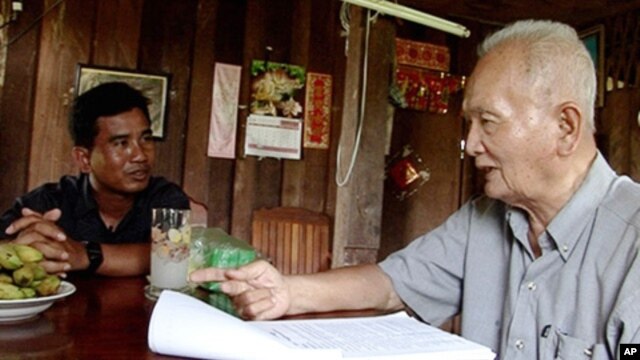
Thet Sambath, filmmaker of the 'Enemies of the People', talking to former Khmer Rouge leader Nuon Chea.
Phnom Penh cinema owners say they are ready and willing to show a groundbreaking documentary on the Khmer Rouge, but the filmmakers say they are so far waiting for government permission for its widespread release.

“Enemies of the People,” which includes lengthy interviews with Pol Pot's lieutenant, Nuon Chea, who is now facing trial for atrocity crimes charges at the UN-backed tribunal, will premier in a small arts theater this week.

Tuesday, July 20, 2010

Cambodia To Seek Protection From Chemical Imports

Pich Samnang, VOA Khmer
Tuesday, 20 July 2010

Cambodia is planning to apply to an international convention that could help reduce the number of illegal hazardous chemicals coming into the country, a senior official said last week.

The government is considering application to the UN’s Rotterdam Convention, which outlines responsibilities of states towards each other regarding chemicals.

“The ministry is considering convention membership because we want to prevent other countries from using Cambodia as a trash bin for their hazardous chemicals and pesticides,” Agriculture Minister Chan Sarun told a meeting of government and development officials on July 14.

Friday, July 16, 2010

Universities Fail at Critical Thinking: Student Advocate

Pich Samnang, VOA Khmer
Friday, 16 July 2010

Cambodia’s higher education system has failed to address a lack of critical-thinking and problem-solving curricula among university students, a youth advocate told “Hello VOA” on Monday.

Instead, says Cheang Sokha, head of the Youth Resource Development Program, “student-centered” approaches exist on paper only within higher education.

Wednesday, June 16, 2010

Youth Voice Lost To Policymakers: Group

Pich Samnang, VOA Khmer
Wednesday, 16 June 2010 

Cambodia’s youth outstrips the rest of the population by a growing margin, but youth advocates say their voices still go unheard.

“Youth voices are excluded from any decision-making processes in social development, from the grass-root to the national level, because the elders often think that the young lack experience or have a low level of education,” Preap Kol, president of the Outstanding Youth Group, told “Hello VOA” Monday.

Preap Kol, who is also the founder of the newly-established volunteer youth group, said youth today are well educated and capable of contributing to social development, but their elders often think of them as useless.

Wednesday, June 9, 2010

Gulf Spill a Reminder of Cambodia Shortfalls

Pich Samnang, VOA Khmer
Wednesday, 09 June

As the US grapples with the implications of the Gulf Coast oil spill, environmental and other groups in Cambodia say the country needs to do more to safeguard its own environment as it moves toward increased oil and gas exploration.

The BP oil spill, now in its sixth week, has poured thousands of barrels of oil into the sea. The environmental costs are likely to be huge, but the political costs are now beginning to mount for the US administration.

Analysts in Cambodia say that if the country does not want to undergo a similar experience, the government must put in place certain protective mechanisms.

Saturday, June 5, 2010

Minorities Face Continued Conflict with Plantations

Pich Samnang, VOA Khmer
Saturday, 05 June 2010

Pheng Krong worked one day sawing at a piece of wood for construction of a new house. The 37-year-old farmer of the Brov ethnic group had plans to replace his small wooden house in Ta Gnach village, in Ratanakkiri’s Ta Veng district. What he did not have plans to do, however, is work on a patch of farmland 2 kilometers down the road.

That’s because that land has been overtaken by a rubber plantation concession.

“I no longer develop on my land because I feel I can’t live here longer,” he told VOA Khmer recently. “The villagers here do not care about planting or farming on their land any more because it will be a waste of time.”

Thursday, June 3, 2010

‘Monster’ Band Digitizes Traditional Sound

Pich Samnang, VOA Khmer
Thursday, 03 June 2010 

A group of young Cambodian and foreign musicians have begun playing contemporary forms of Cambodian music. Krom Monster uses five traditional instruments combined with digital manipulation to create music that appeals to younger Cambodians.

The band, made up of five Cambodians and one Briton, is part of a trend in collaboration between modern and classic artists underway in Cambodia.

Saturday, May 29, 2010

In Modern Stoneworks, an Echo of the Past

Pich Samnang, VOA Khmer
Saturday, 29 May 2010

One of the 26 pieces of modern stone sculptures on display at a new exhibition hall at the Royal University of Fine Arts in Phnom Penh
Though the temples of Angkor Wat have some amazing stone carvings, contemporary sculpture in the country has not been widespread.

But a group of 14 young Cambodian sculptors wants to change that. They currently have 26 pieces of modern stone sculptures on display at a new exhibition hall at the Royal University of Fine Arts in Phnom Penh.

Friday, May 28, 2010

Hydrodam Plans Stir Ratanakkiri Unease

Pich Samnang, VOA Khmer
Friday, 28 May 2010

Patt Paing has five hectares of land by the Sre Pok river. She has a small wooden house, and she raises pigs. The 55-year-old leads a quiet life here in Village Two, in Ratanakkiri’s Koun Mom district. But over the past three years, life has been more difficult.

That’s because of the floods.

“I don’t have enough rice to eat because of the floods for the past three years,” she told VOA Khmer in an interview last week. “In previous years, I could harvest more than 1,000 buckets or over 10 tons of rice per season.”

The floods were caused by water releases from dams upriver, she said.